


Page 5 - hypertension_newsletter9
P. 5
REFLECTIONS
                                                                                                                   Hypertension
     Hypertension Global Newsletter #9 2025


                           The ratio of certainty/uncertainty in the ESH 2013, 2018, and 2023 guidelines           Hypertension


                                           The certainty index in the ESH guidelines


                     C, certainty; UC, uncertainty.


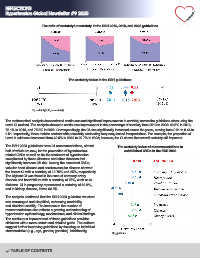
     The mathematical analysis demonstrated continuous and significant improvements in certainty across the guidelines when using the
     novel CI method. The analysis showed a continuous improvement in the percentage of certainty from 2013 to 2023: 60.5% in 2013,
     72.1% in 2018, and 75.3% in 2023. Correspondingly, the CI also significantly increased across the years, moving from 0.21 to 0.44 to
     0.51. Importantly, these metrics contrast with potentially misleading frequency-based interpretations. For example, the proportion of
     Level A evidence decreased from 42.0% in 2018 to 22.7% in 2023; however, the CI shows that overall certainty still improved.

     The ESH 2023 guidelines have 94 recommendations, almost             The certainty index of recommendations in
     half of which are new, for the prevention of hypertension-              established CVDs in the ESH 2023
     related CVDs as well as for the treatment of hypertension
     complicated by these diseases and other diseases that
     significantly increase CV risk. Among the examined CVDs,
     valvular heart disease and cerebrovascular disease showed
     the lowest CI with a certainty of 18.75% and 25%, respectively.
     The highest CI was found in the case of coronary artery
     disease and heart failure with a certainty of 75%, such as in
     diabetes. CI in pregnancy represented a certainty of 68.8%,
     and in kidney disease, it was 62.5%

     The analysis confirmed that the ESH 2023 guideline structure
     was rearranged and simplified, enhancing readability
     and clinician usability. The increase in the number of
     recommendations also reflects a growing understanding of
     hypertension epidemiology, mechanisms, and clinical findings.
     The continuous improvement of these guidelines provides
     clinicians with a more certain and detailed guide. The authors
     suggest further improving guidelines by focusing on individual
     characteristics (e.g., age, gender, genetics). Additionally,    GL, guideline.


          TABLE OF CONTENTS

